2026 Best Floor Grating Types for Global Buyers?
Choosing the right Floor Grating in 2026 will require more than comparing price per square metre. Global buyers must examine load capacity, span, slip resistance, corrosion exposure, drainage, and installation conditions. A platform above a wet processing line needs different protection from a pedestrian walkway near the coast. Small details matter.
Grand View Research identifies metal grating as a growing industrial materials segment, supported by infrastructure, energy, and manufacturing demand. MarketsandMarkets also highlights corrosion-resistant materials as an important direction in industrial flooring. However, published forecasts differ in market size and growth rate. That difference deserves caution. Buyers should verify assumptions, regional coverage, and product definitions before trusting a headline figure.
Industrial flooring specialist Robert J. MacDonald states, “A grating system is only as reliable as its load path, support structure, and installation.” This practical view reflects the principles behind NAAMM MBG guidance, EN 1090 requirements, and relevant workplace safety standards. Product data should show bearing-bar dimensions, mesh spacing, deflection limits, surface treatment, and test methods. It should also identify whether the panel is steel, aluminium, stainless steel, or FRP.
The 2026 market will not have one universal best type. Pressed steel grating may suit heavy plant areas. Stainless steel can perform better in hygienic or corrosive environments. FRP offers useful electrical insulation and chemical resistance, but its structural limits require careful checking. This guide compares the leading Floor Grating types for global buyers, while acknowledging an uncomfortable truth: specification errors often appear only after installation.
What Is Floor Grating and Why Does Type Selection Matter?
What Is Floor Grating and Why Does Type Selection Matter?
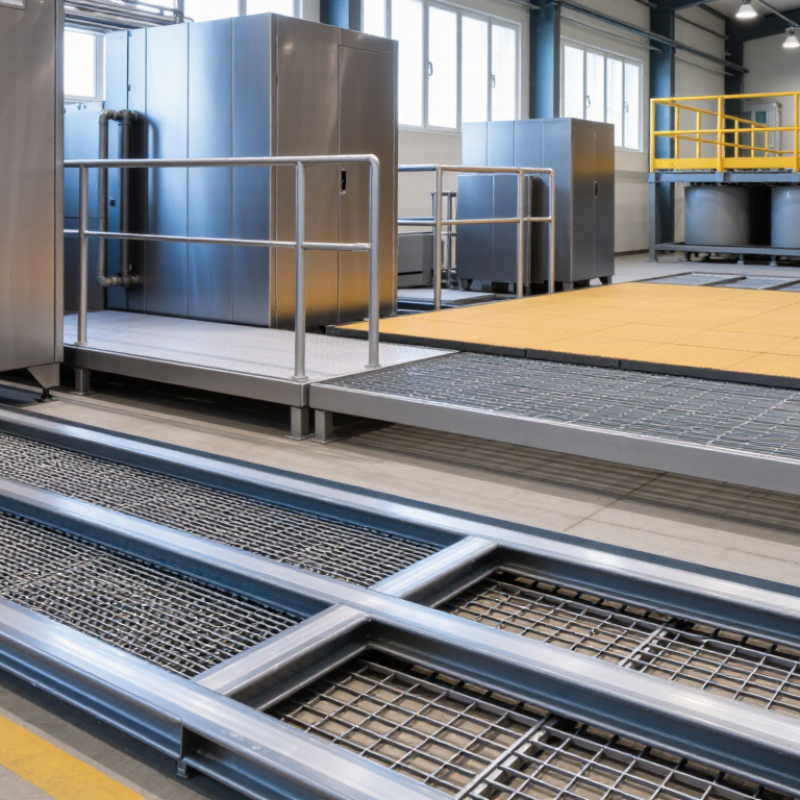
Floor grating is a load-bearing panel made from parallel bars, crossbars, or molded resin structures. It creates a walking surface while allowing water, air, light, and debris to pass through.
Common types include welded steel, press-locked aluminum, riveted grating, and molded fiberglass-reinforced plastic. Each behaves differently under weight, corrosion, heat, and foot traffic.
Type selection matters because the wrong panel can flex, corrode, or become slippery. ISO 14122-2 requires industrial access floors to provide suitable strength, stability, and safe passage. The standard does not choose the material for you. That decision depends on span, load class, drainage needs, and maintenance conditions.
In wet areas, smaller openings and serrated surfaces may improve traction. In chemical zones, molded composite grating can reduce corrosion concerns, although resin performance must be checked carefully.
The International Labour Organization reported 2.93 million work-related deaths annually in its 2023 global estimates.
That figure makes access-surface design more than a purchasing detail. The 2024 World Steel in Figures report recorded roughly 1.89 billion tonnes of crude steel production in 2023, showing steel’s continuing industrial importance. Still, steel is not automatically the best option.
An engineer should verify deflection, support spacing, fasteners, fire behavior, and local requirements before ordering.
Site measurements also deserve skepticism. A small error in span can change the required grating depth. Catalog tables help, but they cannot replace field judgment.
How Do Steel, Aluminum, FRP, and Stainless Steel Gratings Compare?
2026 Best Floor Grating Types for Global Buyers?
Steel, aluminum, FRP, and stainless steel gratings solve different site problems. Steel offers high load capacity and impact resistance at a competitive cost. The World Steel Association reported about 1.88 billion tonnes of crude steel production in 2024, showing its broad industrial availability. However, untreated steel can rust quickly near saltwater, acids, and wet processing areas.
Aluminum is lighter and easier to install. The International Aluminium Institute recorded approximately 72.9 million tonnes of primary aluminum production in 2024. It suits roofs, platforms, and areas where lifting equipment is limited. Stainless steel provides stronger corrosion protection, especially in food, pharmaceutical, and coastal facilities. The International Stainless Steel Forum reported global stainless production near 62 million tonnes in 2024. FRP grating resists corrosion, conducts little electricity, and needs less repainting. Its lower stiffness can create noticeable flexing across long spans. That detail is often underestimated.
Tips: Confirm span, deflection, surface temperature, chemical exposure, and slip requirements before choosing. Use load tables from qualified manufacturers and check local engineering standards. In my experience, a galvanized steel panel may outperform FRP under heavy forklift traffic, while FRP can win beside chlorine tanks. Cost comparisons also need caution. A cheaper panel may demand more cleaning, coating, or replacement. The perfect material does not exist. Specification errors do.
Which Floor Grating Designs Suit Different Industrial Applications?
2026 Best Floor Grating Types for Global Buyers
Industrial floor grating must match the application, not just the building plan. For wet processing areas, serrated steel grating gives stronger slip resistance under oily boots. HSE’s 2023/24 statistics identify slips, trips, and falls on the same level as 29% of specified workplace injuries. That figure makes surface texture a safety decision, not a visual preference. Press-locked grating suits lighter platforms and clean interiors. Welded steel grating handles heavier loads, forklift traffic, and frequent impact near factories.
Drainage-heavy plants need open mesh patterns. They let water, dust, and small debris pass through quickly. In chemical or coastal environments, stainless steel or properly protected carbon steel can reduce corrosion risk. However, coating alone is not a permanent answer. Chlorides, damaged edges, and poor drainage still attack the panel.
EN ISO 14122-2 and OSHA 1910.22 offer useful references for access platforms, walking surfaces, and housekeeping. Engineers should also verify span, point loads, deflection, opening size, and maintenance access.
Tips: Measure the real load path, not only the stated equipment weight. Check wet traction after installation. A grating that looks strong may flex under a concentrated wheel load. I have seen drawings ignore toe-board clearance and cleaning access. That mistake becomes expensive later. Ask for load tables, material certificates, and corrosion assumptions before approval. No catalogue replaces a site walk.
What Standards and Performance Factors Should Global Buyers Check?
2026 Best Floor Grating Types for Global Buyers?
Choosing floor grating requires more than comparing prices and bar spacing. Buyers should confirm the intended load, clear span, traffic pattern, and installation environment. A warehouse walkway may need different performance from a chemical plant platform. Steel, aluminum, and stainless steel each behave differently under impact, moisture, and temperature changes. The safest specification includes load calculations, deflection limits, bearing-bar dimensions, and verified support conditions.
Standards provide a practical starting point. ISO 14122-2 can guide permanent platforms and walkways, while EN 1090 may apply to structural steel fabrication in relevant markets. For hot-dip galvanized products, ASTM A123/A123M or ISO 1461 can help define coating requirements. Check local rules too. They may address slip resistance, openings, accessibility, fire behavior, and edge protection. Ask for material certificates, weld inspection records, coating measurements, and dimensional reports. These documents reveal more than a polished product photo. Yet paperwork is not proof of real performance; independent testing may still be necessary.
Tips: Match the grating to its environment, not only its load rating. Inspect drainage, corrosion risks, heel-safe openings, and surface grip. Small errors matter. I have seen projects overlook support tolerances, creating loose panels and noisy foot traffic. Recheck the design after delivery, because transport damage and site modifications can change performance. A slightly conservative specification often prevents expensive replacement later.