2026 Best Aluminium Sliding Doors for Global Buyers
In 2026, global buyers are not choosing aluminium sliding doors for appearance alone. They are comparing thermal performance, opening size, security, drainage, and long-term service support. A door that glides quietly in a showroom may behave differently beside a salt-heavy coastline or a dusty construction site. Details matter.
The International Energy Agency reports that buildings account for around 30% of global energy demand and 26% of energy-related emissions. This makes frame design, glazing, seals, and installation quality commercially important. The 2024 IEA Global Status Report for Buildings and Construction also highlights the urgent need for better building efficiency. Meanwhile, Grand View Research’s aluminium windows and doors market analysis identifies renovation, urbanisation, and energy-efficient construction as major growth drivers. Forecasts vary by region and methodology. They are useful, but not perfect.
Architect Ludwig Mies van der Rohe famously said, “Less is more.” His principle suits modern aluminium sliding doors, where slim sightlines should create more daylight without sacrificing structural stability. Yet minimal frames can expose weaknesses when rollers, locks, or gaskets are poorly specified. That is the uncomfortable part.
This 2026 guide examines tested configurations, credible performance claims, and practical buying risks. It considers thermal breaks, glass specifications, wind loads, corrosion resistance, accessibility, and spare-part availability. Global buyers should request test evidence, not attractive promises. A beautiful door is not automatically a reliable door. Supplier experience, local climate, installation training, and warranty clarity may matter more than a slightly thinner profile.
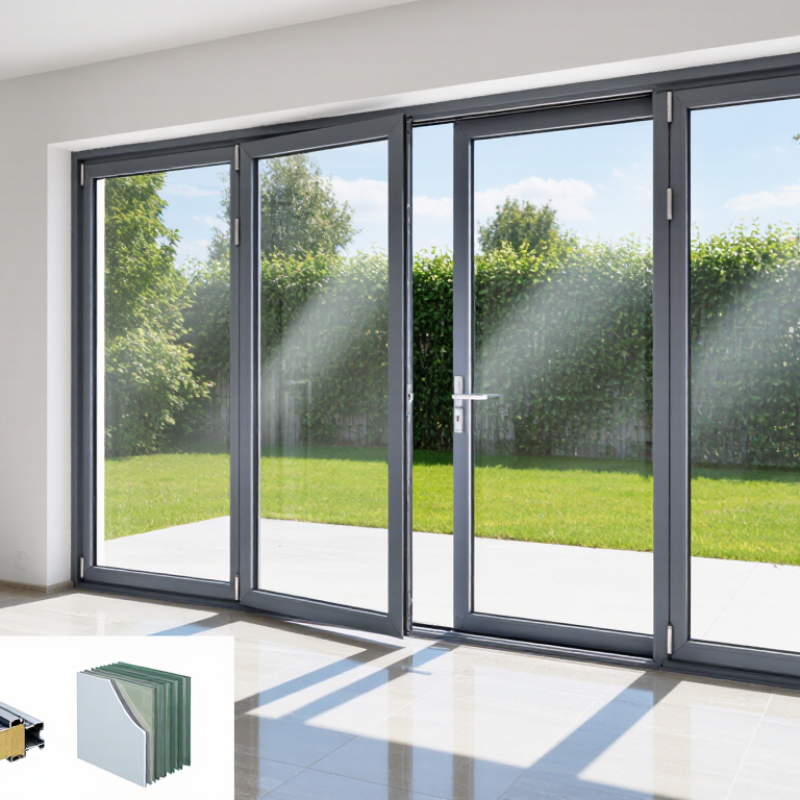
Aluminium Sliding Doors in 2026: Thermal Breaks and Uw ≤1.3 W/m²K (EN 10077-1)
2026 Best Aluminium Sliding Doors for Global Buyers
Aluminium sliding doors are moving toward tighter thermal targets in 2026. A Uw value of 1.3 W/m²K or lower is now a practical benchmark for many energy-conscious projects. Uw measures the complete door assembly, including the frame, glass, and edge spacer. It is not the frame value alone. That distinction matters.
Thermal breaks separate the inner and outer aluminium sections. Polyamide strips, insulated chambers, and carefully designed drainage reduce heat transfer. Low-emissivity double glazing may improve performance further. However, glass selection can change the final Uw significantly. Ask for calculations based on EN 10077-1 and the exact door dimensions. Standard-size results may not represent a large opening.
Installation remains critical. A well-designed door can lose performance through gaps, poor sill support, or compressed seals. On site, check frame alignment, perimeter insulation, and water drainage. Small errors become noticeable beside a cold floor. Very low Uw also does not guarantee comfort everywhere. Solar exposure, wind, humidity, and local heating habits affect results. Global buyers should request thermal calculations, test evidence, air-tightness data, and installation guidance. Documents deserve careful review. A lower number may look impressive, but unclear assumptions can weaken its value.
Air Tightness: Class 4 Tested at 600 Pa Under EN 12207
Air tightness is not a marketing detail. It affects comfort, heating demand, and indoor noise. The International Energy Agency’s Energy Efficiency 2023 report states that buildings consume about 30% of global final energy. A poorly sealed sliding door can increase unwanted heat exchange, especially across exposed façades.
Class 4 under EN 12207 is the highest air-permeability classification commonly used for windows and doors. The test applies pressure up to 600 Pa, simulating severe wind exposure. Test engineers check leakage through the frame, sash, seals, and locking points. This process gives buyers a comparable laboratory benchmark. It does not promise identical results on every building.
Small gaps matter. A good aluminium frame needs continuous gaskets, accurate corner joints, and stable rollers. The interlock should close firmly without excessive force. Drainage paths also need careful design, because blocked channels can weaken long-term sealing. Installation remains decisive. A twisted opening or uneven sill may reduce performance, even when the product passes testing. That is the uncomfortable part. Class 4 proves tested performance, not careless installation. Buyers should request the complete EN 12207 test report, tested dimensions, pressure sequence, and installation conditions. Those details reveal more than a single rating.
Water Resistance: Class 9A Tested at 600 Pa Under EN 12208
2026 Best Aluminium Sliding Doors for Global Buyers
Water resistance deserves more than a marketing phrase. Class 9A under EN 12208 means the sliding door resisted water penetration at 600 Pa during laboratory testing. This pressure represents severe wind-driven rain. It does not mean flood protection. Real performance depends on the frame, glass, gaskets, drainage, and installation.
The 2023 Global Status Report for Buildings and Construction states that buildings consume about 34% of global energy and create 37% of energy-related emissions. Durable envelope components can reduce premature replacement and moisture damage. Yet, a Class 9A result cannot guarantee identical performance on every building. Coastal exposure, blocked weep holes, uneven tracks, and poor perimeter sealing may change the outcome. A careful buyer should request the test report, laboratory details, product size, and installation conditions. A smaller test sample can perform differently from a large sliding panel.
Tips: Check drainage slots before installation. Keep the sill level. Confirm compatible flashing and sealants. Inspect gaskets after harsh weather. Ask whether the test covered the exact configuration being ordered. Small details matter. Water usually finds the weak joint first.
2026 Best Aluminium Sliding Doors for Global Buyers - Water Resistance: Class 9A Tested at 600 Pa Under EN 12208
| Performance Dimension | Recommended Reference | Typical Global-Buyer Range | Verification Basis |
|---|---|---|---|
| Water resistance | Class 9A | 600 Pa test pressure | EN 12208 classification; request the complete test report for the specified door size and configuration. |
| Water test duration | 55 minutes at Class 9A pressure sequence | As defined by the applicable EN 12208 test sequence | Laboratory test documentation and specimen details. |
| Air permeability | Class 3 or Class 4 | Lower air leakage is preferred for conditioned buildings | EN 12207 test classification; performance depends on seals, vents, joints and installation. |
| Resistance to wind load | Project-specific classification | Common residential targets: Class C3–C5, subject to size and location | EN 12210; wind-zone calculation must consider building height, exposure and panel dimensions. |
| Thermal transmittance | Uw approximately 1.2–2.0 W/(m²·K) | Thermally broken aluminium frame with low-emissivity insulated glazing | EN ISO 10077-1 or EN ISO 10077-2 calculation; report the declared door size and glazing build-up. |
| Glazing configuration | Double or triple insulating glass unit | Typical thickness: 24–52 mm; low-E coating and argon filling may be specified | Confirm glass composition, safety-glass requirement, spacer type and total thickness. |
| Acoustic performance | Rw approximately 30–42 dB | Higher values generally require laminated acoustic glass and optimized seals | EN ISO 10140 laboratory testing; distinguish Rw from traffic-noise spectrum terms. |
| Panel operating load | Hardware selected for the actual sash weight | Approx. 200–400 kg per sliding panel for heavy-duty systems | Confirm the tested hardware capacity, glass weight, panel width and operating-cycle data. |
| Track and drainage design | Multi-chamber sill with isolated drainage paths | Recessed, flush or raised sill options depending on accessibility and exposure | Review drainage outlets, end dams, sill flashing and installation details. |
| Aluminium finish | Powder coating or anodizing suitable for the exposure category | Typical powder-coating thickness: approximately 60–120 μm, subject to specification | Confirm coating standard, pretreatment, color tolerance and coastal-exposure suitability. |
| Security provisions | Multi-point locking with anti-lift protection | Laminated safety glass and lockable handles may be specified | Where required, request testing to the applicable local security standard. |
| Maximum practical opening size | Engineering-dependent | Typical individual panel widths: approximately 0.8–3.5 m | Structural calculations must address glass weight, wind load, deflection, transport and installation. |
| Recommended installation tolerance | Follow the approved installation manual | Level, plumb and square opening; allow movement and perimeter sealing | Installation quality can materially affect water, air and thermal performance. |
Wind Safety: C5 Rated at 2,000 Pa Under EN 12210
2026 Best Aluminium Sliding Doors for Global Buyers
Wind Safety: C5 Rated at 2,000 Pa Under EN 12210
For exposed buildings, wind resistance deserves more than a sales label. A C5 rating under EN 12210 indicates tested resistance at 2,000 Pa. That pressure is significant for large sliding doors facing coastal weather, open fields, or upper-floor conditions. During evaluation, the door frame, panels, seals, and locking points must remain functional after controlled pressure is applied. The result offers useful evidence, not empty confidence.
In real projects, installation can change everything. A strong door may perform poorly if anchors are spaced incorrectly or the surrounding wall is weak. Check the glass specification, frame depth, interlock design, drainage paths, and track support. Ask for test documentation that identifies the complete door system, not only one component. Site exposure, building height, opening size, and local engineering requirements still need review. I have seen impressive ratings lose value when fitting details were treated as an afterthought.
Tips: Confirm whether 2,000 Pa applies to the selected size. Use qualified installers familiar with EN 12210 testing. Inspect rollers, seals, and locking points after severe weather. Keep drainage channels clear. Do not confuse wind classification with waterproofing or impact resistance. That distinction is easy to miss.
Global Compliance: CE, NFRC 100, and AS/NZS 2047 Benchmarks
For global buyers, the best aluminium sliding doors must meet local performance expectations, not just look modern. In European projects, CE marking supports conformity with applicable safety and construction requirements. It is not a complete energy or weatherproofing rating. Buyers should request the Declaration of Performance, test scope, and installation instructions. On site, I have seen excellent doors perform poorly after careless fitting. Small gaps matter.
NFRC 100 provides a recognized method for measuring U-factor in North American markets. This value indicates how quickly heat passes through the complete door assembly. Lower values usually support better thermal efficiency. However, buyers should compare the frame, glass, spacer, and tested door size together. A quoted glass result may not represent the finished product. That distinction is easy to miss.
In Australia and New Zealand, AS/NZS 2047 evaluates windows and doors for air infiltration, water penetration, structural strength, and operating forces. A compliant sliding door should suit local wind pressures and exposure conditions. Ask for current laboratory reports, product dimensions, hardware details, and installation limits. Coastal sites need careful attention to corrosion resistance. Some specifications remain unclear, and that deserves challenge. Certification can confirm testing, but proper drainage, alignment, and sealing still depend on the installer.
Related Posts
-
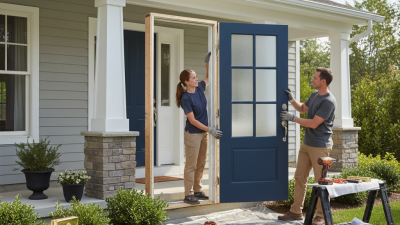
How to Successfully Replace Your Exterior Door in Just a Few Easy Steps
-
The Ultimate Guide to Choosing Exterior Front Doors That Enhance Curb Appeal and Energy Efficiency
-
Transform Your Home's Aesthetic: The Ultimate Guide to Choosing French Doors
-
Maximize Energy Efficiency: The Top 5 Benefits of Upgrading Your Residential Windows in 2023
-
How to Choose the Best Exterior Sliding Doors for Your Home?
-
Why Choosing the Right Exterior Front Doors Matters for Your Home